

TL;DR
If you have diabetes, high blood pressure, or both, your kidneys are doing more work than most people realise. Early chronic kidney disease is silent, and the standard outpatient blood panel often misses it. A single test called the urine albumin-to-creatinine ratio (UACR) can identify kidney damage years before your creatinine moves out of the normal range. The KDIGO international guidelines recommend annual screening for adults with diabetes or hypertension, but in Indian primary care, the UACR is frequently not ordered. An independent nephrology review of your records can tell you whether your screening is complete and whether your current findings warrant earlier specialist involvement.
---
The clinical moment
You have had diabetes for 10 years. Your blood pressure has been managed on medication. Your last full health check showed your creatinine at 1.3 mg/dL. The doctor said it was at the upper end of normal but nothing to worry about. Six months later, your creatinine was 1.5. The doctor said the same thing. You did not have specific symptoms, but you noticed your ankles swelling slightly in the evenings. The doctor attributed it to standing too long.
This is one of the most quietly important situations in Indian outpatient medicine. A slowly rising creatinine in a patient with diabetes or hypertension is the textbook signature of chronic kidney disease (CKD). It is also the signature most easily missed, because the absolute numbers stay technically within or just above the reference range until the kidney function has already lost a meaningful share of its reserve.
By the time symptoms appear, CKD is usually in Stage 4 or 5. By then, the conversation has shifted from prevention to preparation for dialysis or transplant. The gap between where this story can be caught (Stage 1 or 2) and where it usually gets caught in Indian primary care (Stage 4 or later) is where independent review can make the most difference.
---
What the evidence says
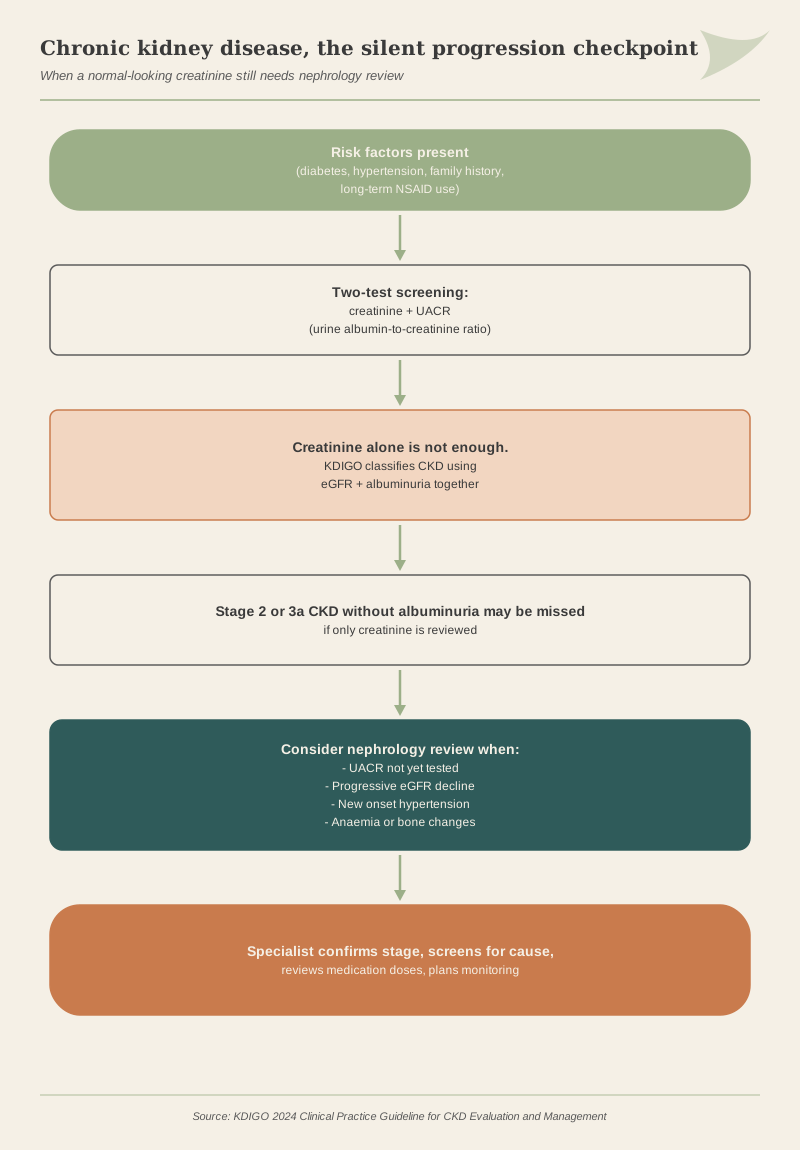
How CKD is actually classified
The current international standard for CKD evaluation is the KDIGO (Kidney Disease: Improving Global Outcomes) guideline, with the 2024 update being the most recent comprehensive version. KDIGO classifies CKD using two parameters together, not creatinine alone.
**Glomerular filtration rate (GFR).** GFR is an estimate of how much blood your kidneys filter per minute. It is calculated (not measured directly) using your creatinine, age, and sex. The current recommended formula is the CKD-EPI 2021 equation, published in NEJM by Inker and colleagues in 2021. Older formulas overestimated GFR in certain populations. The 2021 update is the current standard worldwide.
GFR is divided into stages:
- check_circleG1: GFR 90 or higher (normal)
- check_circleG2: GFR 60 to 89 (mildly decreased)
- check_circleG3a: GFR 45 to 59 (mildly to moderately decreased)
- check_circleG3b: GFR 30 to 44 (moderately to severely decreased)
- check_circleG4: GFR 15 to 29 (severely decreased)
- check_circleG5: GFR below 15 (kidney failure)
**Albuminuria.** This is the amount of albumin (a protein) leaking into the urine. It is measured by the urine albumin-to-creatinine ratio (UACR), often on a single spot urine sample. KDIGO divides it into:
- check_circleA1: UACR below 30 mg/g (normal to mildly increased)
- check_circleA2: UACR 30 to 300 mg/g (moderately increased)
- check_circleA3: UACR above 300 mg/g (severely increased)
CKD is defined when either GFR is below 60 for at least 3 months, or albuminuria is A2 or higher, or both. The classification matters because the combination of GFR category and albuminuria category determines the risk of progression and the recommended monitoring frequency.
Why creatinine alone can mislead
Creatinine is a useful number but it does not tell the full story. Two patients with the same creatinine can have very different GFR and very different kidney prognosis depending on age, sex, muscle mass, and albuminuria status. A 70-year-old woman with a creatinine of 1.2 mg/dL has very different kidneys than a 30-year-old man with the same number.
More importantly, a patient can have significant kidney damage with completely normal creatinine if the damage is showing up as albuminuria. The 2024 KDIGO guideline is explicit: in adults with diabetes, hypertension, or other CKD risk factors, screening should include both eGFR (calculated from creatinine) AND UACR on at least an annual basis. Either test alone is not sufficient.
Where Indian practice diverges
India has one of the highest CKD burdens in the world, driven primarily by the country's diabetes and hypertension epidemics. The ICMR-INDIAB studies and multiple Indian Society of Nephrology publications have documented this pattern for years.
The screening gap in Indian primary care has two main components:
- 1**UACR is frequently not ordered.** A standard "diabetes panel" or "renal function test" in Indian outpatient settings typically includes creatinine and BUN (blood urea nitrogen). The urine albumin component is often a separate, additional test that gets skipped, either because the patient is asymptomatic, or because the protocol does not include it routinely, or because the patient does not understand its importance enough to push for it.
- 1**Late referral.** When CKD is identified, referral to a nephrologist often does not happen until Stage 4 or later, by which time many therapeutic options have narrowed.
The international literature has shown for decades that earlier nephrology involvement, even at Stage 3a or 3b, slows progression and improves outcomes. The Indian gap is a system-level issue, not a knowledge gap among nephrologists. It is what happens before the patient ever reaches a nephrologist that matters most.
---
What this means for your case
A nephrology second opinion is most useful when one or more of the following apply:
- check_circleYou have diabetes, hypertension, or both, and you have not had a UACR in the last 12 months
- check_circleYour creatinine has trended upward over the last 1 to 3 years (even within the normal range)
- check_circleYou have a family history of kidney disease
- check_circleYou have unexplained anemia, fatigue, or ankle swelling
- check_circleYou have been told your kidney function is "borderline" but no specific stage has been assigned
- check_circleYou are on medications that can affect kidney function (NSAIDs, ACE inhibitors or ARBs, certain antibiotics) and the monitoring has not been clearly documented
- check_circleYou have heart failure, urinary tract issues, or other conditions associated with secondary kidney disease
Diabetes is behind a large share of kidney disease in India. If your blood sugar has been the harder problem to control, an endocrinology second opinion looks at that part of your records.
Questions worth asking your physician include:
- check_circleWhat is my eGFR using the CKD-EPI 2021 equation?
- check_circleWhat was my last UACR? When was it done?
- check_circleBased on KDIGO 2024 staging, what category am I in?
- check_circleWhat is my expected progression risk based on my GFR and UACR together?
- check_circleShould I be on an ACE inhibitor, ARB, SGLT2 inhibitor, or other medication that has been shown to slow CKD progression in patients with my profile?
- check_circleAt what point in my CKD course would a nephrology referral be appropriate?
A specialist review in this area would typically assess your full kidney panel history (creatinine trend, UACR, electrolytes), your current medications, your blood pressure control, your diabetes control if applicable, and how your specific stage maps to current KDIGO monitoring and management recommendations.
---
What a US specialist review evaluates
A nephrology educational review through Tidbit is a structured assessment of the records that drive CKD evaluation and treatment decisions. The reviewer is a US board-certified nephrologist in active practice at a major American academic medical center.
The review covers your kidney function history (creatinine, eGFR, UACR over time), your other relevant lab values (electrolytes, hemoglobin, parathyroid hormone if available, vitamin D), your current medication list with attention to nephrotoxic and renoprotective agents, your blood pressure and diabetes control trends, and your overall cardiovascular risk profile.
It produces a written educational document that summarises what your records show, how your situation maps to current KDIGO staging, what the international evidence says about your specific stage and risk profile, what medications and monitoring would typically be recommended at your stage, and what questions you might raise with your local treating physician.
The review is educational. It does not produce a clinical diagnosis or a treatment plan, and it does not replace your relationship with your treating physician or nephrologist. It gives you a second, independent, evidence-based perspective during a window when the management decisions you make today will affect your kidney trajectory over the next decade.
For related guidance on hidden risk that standard checkups miss, see our guide Normal BMI, Hidden Risk: Why Standard Checkups Miss Metabolic Disease in Indian Patients.
---
When NOT to wait
If you are experiencing any of the following, do not wait for a remote second opinion. Contact your local physician or visit your nearest casualty immediately:
- check_circleAcute decrease in urine output (sudden inability to urinate or markedly reduced volume)
- check_circleSudden swelling of face, legs, or abdomen
- check_circleConfusion, drowsiness, or change in mental status (can indicate severe metabolic derangement)
- check_circleChest pain or severe shortness of breath
- check_circleHeavy nausea and vomiting that prevents oral intake
- check_circleKnown kidney disease with sudden weakness or muscle cramps (possible electrolyte emergency)
These can be presentations of acute kidney injury or severe metabolic disturbance that require same-day evaluation.
The Tidbit nephrology second opinion service is for patients with stable but evolving kidney function findings, records in hand, and time to make informed decisions about monitoring and management.
---
Frequently Asked Questions
Why does creatinine alone miss early kidney disease?
expand_more
Creatinine has a high natural variation and only rises out of the normal range after a meaningful loss of kidney function. By the time it moves, the disease can already be in stage 3 or later. KDIGO international guidelines therefore classify chronic kidney disease using two parameters together: estimated glomerular filtration rate (eGFR) and albuminuria (measured by the urine albumin-to-creatinine ratio).
What is the UACR test and why does it matter?
expand_more
The urine albumin-to-creatinine ratio (UACR) detects small amounts of protein in the urine that signal early kidney damage. It can identify kidney injury years before creatinine moves out of the normal range. The KDIGO 2024 guidelines recommend annual UACR screening for adults with diabetes, hypertension, or other CKD risk factors.
When should an Indian patient consider a nephrology second opinion?
expand_more
Consider a nephrology review when your UACR has not been tested despite diabetes or hypertension, when your eGFR has been declining over the past 2 to 3 years, when you have new-onset hypertension that is hard to control, or when you have early signs like anaemia or bone changes that may be CKD-related.
What does a nephrology second opinion evaluate?
expand_more
An independent nephrology review evaluates whether the CKD stage has been correctly classified using both eGFR and albuminuria, whether the underlying cause has been adequately screened, whether your medication doses (especially for diabetes, blood pressure, and pain) are appropriate for your current kidney function, and whether the monitoring plan matches KDIGO guidance.
Is a written second opinion useful if I am not yet on dialysis?
expand_more
Yes. The biggest leverage of a nephrology second opinion is in stages 1 to 3a, when the disease is silent and decisions about screening, blood pressure targets, and medication choices can meaningfully change the trajectory. By stages 4 and 5, the conversation shifts to dialysis or transplant preparation, where local specialist involvement is essential.
Ready to get a U.S. specialist's view of your case?
Nephrology Second Opinion Review
